
Hepatitis C remains one of the most commonly reported blood-borne infections in the United States and continues to cause significant morbidity and mortality when undiagnosed or untreated. Nationally, hepatitis C infection disproportionately affects individuals in correctional settings, with a rate approximately 10 times higher as compared to the general population[1]. The New York State Hepatitis C Elimination Plan identifies those currently or formerly involved in the justice system as a priority population and correctional settings, including local jails, courthouses, and prisons, as priority settings.
As published in the 2024 New York State Hepatitis B and C Annual Report, between 2012 and 2024, 4,944 hepatitis C diagnoses were first reported to the New York State Department of Health among individuals under custody at a New York State prison (outside of New York City*), underscoring the long-term burden of hepatitis C in correctional settings in New York.
The trend in both numbers and rates[2] of newly reported hepatitis C diagnoses in New York State prisons (outside of New York City) is better understood in the context of New York State hepatitis C testing laws and policies and the COVID-19 pandemic. In 2014, New York State implemented the Hepatitis C Testing Law, requiring screening for all individuals born between 1945 and 1965, which coincided with a peak in numbers (701) and rates (1,317 per 100,000) of newly reported hepatitis C. Following this surge, numbers and rates began to decline. In 2017, the New York State Department of Corrections and Community Supervision began screening all incarcerated individuals for hepatitis C upon intake at reception facilities[3]. In the early years of the COVID‑19 pandemic, there was an increase in newly reported hepatitis C through 2022. Since then, the decline in hepatitis C diagnoses and rates resumed through 2024.
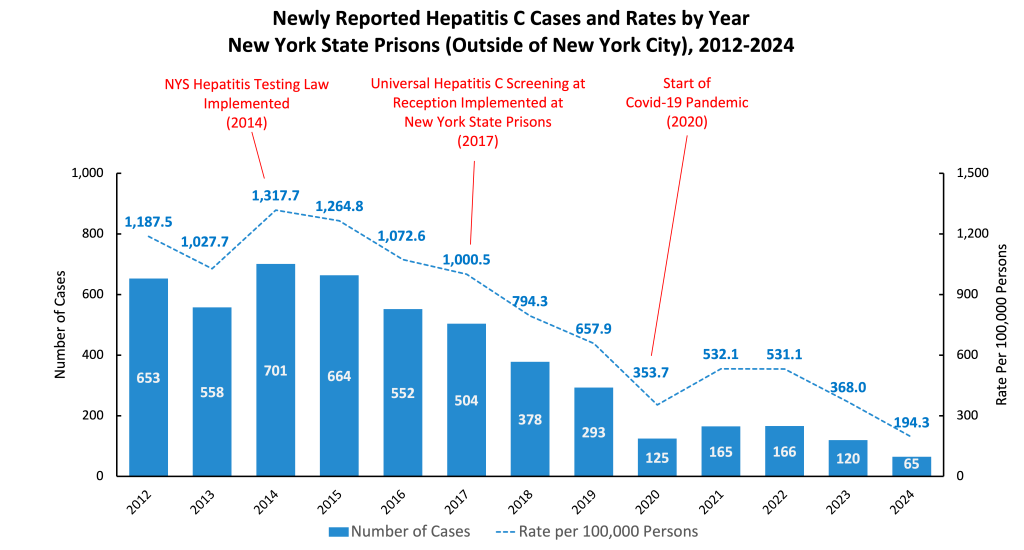
In 2024, 65 individuals were newly reported with hepatitis C while under custody at a New York State prison (outside of New York City). The 91% decrease since 2014, is larger than the 71% decrease seen in the overall New York State (outside of New York City) population during the same time period. However, the 2024 rate of 194.3 per 100,000 far exceeds the overall rate of 22.4 per 100,000 in New York State (outside of New York City).
Hepatitis C Demographics
Non-injection and injection drug use were the most commonly reported risk factors among individuals newly diagnosed with hepatitis C in New York State prisons (outside of New York City), similar to what is seen outside of correctional settings. A higher percentage of individuals with newly reported hepatitis C were female, aged 35-39, or identified as White, than in the overall population under custody at New York State prisons (outside of New York City), indicating that these groups were disproportionately impacted by hepatitis C in 2024.

Conclusion
Although newly reported hepatitis C diagnoses in New York State prisons (outside of New York City) have declined over the past decade, rates are still higher than in the general population. And some demographic groups in correctional settings are more impacted than others. This highlights the importance of continued testing and treatment among at-risk and incarcerated populations.
* This summary only includes individuals first reported with hepatitis C while under the custody of the New York State Department of Corrections and Community Supervision outside of New York City. It does not include individuals first reported with hepatitis C while in a prison or jail located in New York City, or other county jail or federal prison located in New York State.
[1] McNamara M, Furukawa N, Cartwright EJ. Advancing Hepatitis C Elimination through Opt-Out Universal Screening and Treatment in Carceral Settings, United States. Emerging Infectious Diseases. 2024;30(13):80-87. doi:10.3201/eid3013.230859.[2] Rates are calculated based on the number of individuals under custody at the end of each year, extracted from Incarcerated Individuals Under Custody Profiles.
[3]Department of Corrections and Community Supervision. Eliminating Hepatitis C. Hepatitis C in New York State Department of Corrections and Community Supervision (NYSDOCCS). Published 2019. legislative-hep-c-report-1-8-20-final-002.pdf
